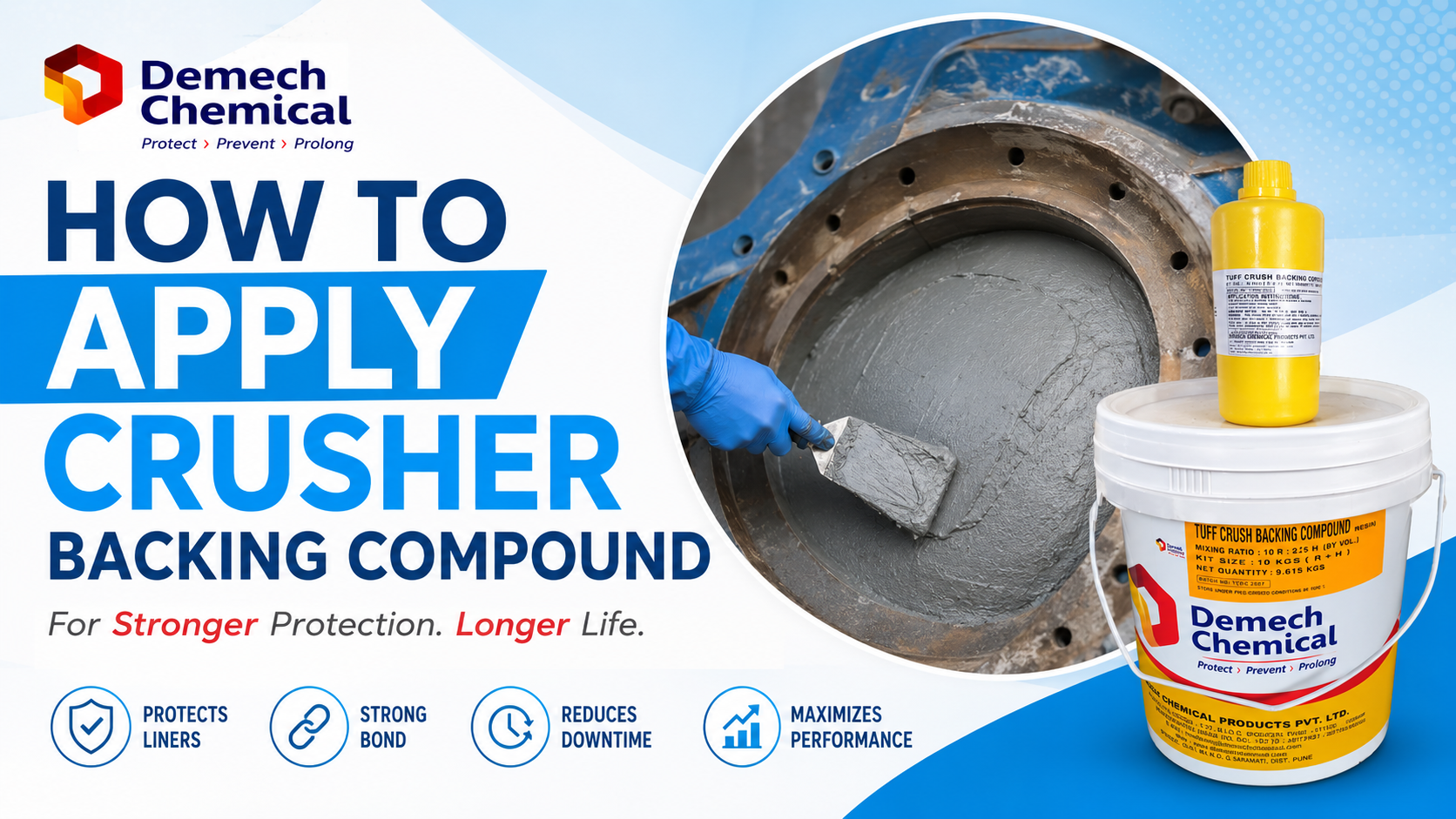
Knowing how to apply crusher backing compound correctly is one of the most important — and most under-documented — tasks in cone crusher maintenance. Pour it wrong, and the backing fails early. Get it right, and your liners can deliver 15–35% longer service life with no other changes to the crusher setup.
This guide walks through the complete process of how to apply crusher backing compound step by step: surface preparation, mixing, pouring, curing, and common mistakes to avoid. It is based on the application guidelines for Tuff Crush Backing Compound by Demech Chemical Products Pvt. Ltd. — India's epoxy backing compound manufacturer serving the mining, cement, and steel sectors since 1993.
Whether you are replacing worn manganese liners or commissioning a rebuilt crusher, this guide gives you the exact technique to apply crusher backing compound with confidence the first time.
Table of Contents
- What You Need Before You Start
- Step-by-Step: How to Apply Crusher Backing Compound
- Curing Time Reference by Temperature
- 5 Common Mistakes — And How to Avoid Them
- Which Tuff Crush Grade Should You Use?
- Storage & Shelf Life
- Frequently Asked Questions
What You Need Before You Start
Before you begin, gather the following materials. Starting the pour without everything on hand is the fastest route to a failed
crusher backing compound application.
- Tuff Crush Backing Compound kit (pre-measured resin + hardener) — 10 KG or 25 KG depending on crusher size
- Demech Chemical Cleaner/Conditioner or equivalent industrial degreaser
- Low-speed stirrer or jiffy mixer (drill-mounted)
- Clean mixing bucket (do not reuse)
- Grease (for threaded and release surfaces)
- Sealant or clay (for sealing drain holes and bottom joints)
- Heat gun or warm air blower (for cold-weather applications)
- Personal Protective Equipment: safety glasses, chemical-resistant gloves, coveralls
| ⚠️ Safety First |
| Tuff Crush crusher backing compound is non-flammable and requires no melting — a major safety advantage over molten zinc.However, curing epoxy can cause skin and eye irritation. Always wear gloves and safety glasses.
In case of eye contact, flush with water immediately and consult a doctor.
This product is for industrial use only. |
Step-by-Step: How to Apply Crusher Backing Compound
The complete process of
how to apply crusher backing compound has eight stages. Each must be completed correctly — skipping or rushing any step is the primary cause of
crusher backing compound failures in the field.
| Step |
Stage |
What to Do |
| 1 |
Surface Preparation |
Remove all rust, mill scale, dirt, grease, and oil from all metallic contact surfaces — both the crusher bowl/frame and the back of the wear liner. Use wire brushing, grinding, or grit blasting to achieve clean, bare metal. Wipe down with Demech Cleaner/Conditioner and allow to dry fully. Contaminated surfaces are the single most common cause of premature crusher backing compound failure. |
| 2 |
Seal All Drainage Points |
Before positioning the liner, seal all drain holes, bottom gaps, and open joints with clay, foam backer rod, or a suitable sealant. Failure to seal adequately will cause the liquid crusher backing compound to drain out before it gels. Check from below that no gaps remain. |
| 3 |
Protect Release Surfaces |
Apply a thin, even coat of grease to all threaded shaft surfaces, liner bolt threads, and any areas where the backing compound must NOT bond permanently (to allow future disassembly). This acts as a release agent. Do not apply grease to surfaces that need to bond. |
| 4 |
Position & Support the Liner |
Lift and seat the manganese wear liner (concave or mantle) into position. Ensure it is correctly centred and seated at its proper height. Support from below if required. The liner must be stable — any movement during the pour will create voids or uneven crusher backing compound distribution. |
| 5 |
Pre-Mix Resin Component |
Before adding hardener, pre-mix the resin component in its original container using a low-speed stirrer for 2–3 minutes. This re-suspends any settled fillers and ensures a uniform base. Do not aerate — keep the mixer head below the liquid surface when preparing your crusher backing compound. |
| 6 |
Add Hardener & Mix Thoroughly |
With the resin still being stirred, slowly pour in the complete hardener contents. Mix for a minimum of 3–4 minutes, scraping consistently from the sides and bottom of the bucket. A correctly mixed crusher backing compound will show a uniform, streak-free colour throughout. Always mix the complete pre-measured kit — never use partial amounts as this risks ratio errors. |
| 7 |
Pour from a Single Point |
Working within the 25-minute working time, pour the mixed crusher backing compound immediately from ONE fixed point — typically the highest accessible opening. Allow it to flow under gravity, pushing air out ahead of the flow front. Never pour from multiple points as this traps air pockets. Continue pouring steadily until compound appears at the vent holes or the cavity is filled. |
| 8 |
Check Fill & Allow to Cure |
After pouring, check the fill level at 10–15 minutes — the crusher backing compound may settle into additional void spaces and a top-up may be required. Then leave undisturbed. At 30°C, functional cure is achieved in 8 hours. Do NOT commission the crusher until full cure is confirmed. |
Curing Time Reference by Temperature
Cure rate is directly affected by ambient temperature and the volume of
crusher backing compound mixed. Use this reference to plan your maintenance window:
| Condition |
Gel Time |
Working Time |
Functional Cure |
| 30°C — Standard |
30 minutes |
25 minutes |
8 hours |
| Below 20°C — Cold |
Extended |
Extended |
12–18 hours (pre-heat substrate) |
| Above 35°C — Hot |
Shortened |
< 20 minutes |
4–6 hours (mix small batches) |
| 🌡️ Temperature Tips for Crusher Backing Compound Application |
| COLD (below 20°C): Give the mixed crusher backing compound 3–5 minutes maturation time in the bucket before pouring. Pre-heat the liner surface to 30–40°C with a heat gun. Do not apply below 5°C.HOT (above 35°C): Mix in smaller batches (half-kit at a time). Pre-cool components in a cool room or on ice before mixing. Work in the coolest part of the day.
LARGE POURS: For gyratory or large cone crushers with pour volumes above 50 litres, mix multiple sequential batches to maintain working time control throughout the crusher backing compound application. |
5 Common Mistakes When Applying Crusher Backing Compound — And How to Avoid Them
Even experienced maintenance teams make errors when learning
how to apply crusher backing compound. These five mistakes account for the vast majority of
crusher backing compound failures in mining and cement plants:
| # |
Mistake |
How to Avoid It |
| 1 |
Poor surface preparation (oil/grease left on metal) |
Thoroughly degrease with Demech Cleaner/Conditioner. Zero tolerance for contamination — it is the #1 cause of crusher backing compound debonding. |
| 2 |
Unsealed bottom joints — compound drains out |
Always check from below and seal every gap with clay or foam backer before applying crusher backing compound. |
| 3 |
Partial kit mixing — ratio errors |
Always mix the complete pre-measured kit. Never estimate or weigh out portions on-site when you apply crusher backing compound. |
| 4 |
Pouring from multiple points — air pockets trapped |
Pour crusher backing compound from a single highest point and let it flow naturally to fill the cavity. |
| 5 |
Commissioning before full cure |
Wait the full 8 hours (or longer in cold conditions) after you apply crusher backing compound before loading. Early loading causes plastic deformation of the uncured compound. |
Which Tuff Crush Grade Should You Use?
Not all cone crushers require the same product. Before you decide
how to apply crusher backing compound, select the right Tuff Crush grade for your application from the
Tuff Crush full product range:
| Crusher Type |
Recommended Grade |
Key Benefit |
| Cone crushers up to 7 ft (secondary/tertiary) |
Tuff Crush Backing Compound (Standard) |
Optimal flow, easy pour, proven compressive strength |
| Large cone crushers & primary applications |
Tuff Crush HP Backing Compound |
Highest compressive & impact strength for heavy-duty use |
| Eccentric bushing locking in cone crushers |
Tuff Crush Locking Compound |
Specifically formulated for bushing retention |
| Dolomite, stone & all-purpose applications |
Tuff Crush Casting Compound |
Good impact strength, versatile for varied crusher types |
For full technical data sheets on each grade, visit the
Crusher & Backing Compounds product page.
Storage & Shelf Life
Proper storage is essential to ensure the
crusher backing compound performs as specified when you apply it on site:
- Store at room temperature (10–30°C) in original sealed packaging
- Keep away from direct sunlight and heat sources
- Do not freeze — freezing permanently damages the hardener component
- Shelf life: 12 months from date of manufacture when stored correctly
- Always check the batch date before use — do not apply expired crusher backing compound on production crushers
Frequently Asked Questions:
How do I apply crusher backing compound in a cone crusher?
To
apply crusher backing compound in a cone crusher: clean and degrease all surfaces, seal drain holes, position the liner, pre-mix the resin, add hardener and mix for 3–4 minutes, pour from a single fixed point, and allow 8 hours to functionally cure at 30°C before commissioning. The complete
how to apply crusher backing compound process is detailed step by step in the guide above.
How long does crusher backing compound take to set?
Tuff Crush
crusher backing compound has a working time of 25 minutes and achieves functional cure in 8 hours at 30°C. Cold conditions (below 20°C) extend cure time to 12–18 hours; hot conditions (above 35°C) shorten working time to under 20 minutes. Always wait for full functional cure before loading the crusher after you
apply crusher backing compound.
Can I mix a partial kit of crusher backing compound?
No. Always mix the complete pre-measured kit when you
apply crusher backing compound. Tuff Crush kits are ratio-matched at the factory (100:6 by weight). Mixing partial amounts introduces ratio error, which causes incomplete cure, soft spots, and structural failure of the backing layer.
What happens if I pour crusher backing compound from multiple points?
Pouring
crusher backing compound from multiple points traps air pockets between flow fronts, creating voids in the cured backing. These voids allow liner flexing under load and accelerate fatigue cracking. When deciding
how to apply crusher backing compound, always pour from one fixed highest point and let it flow naturally.
Do I need to preheat the liner before applying crusher backing compound?
In cold conditions (below 20°C), yes — pre-heating the liner surface to 30–40°C with a heat gun significantly improves compound flow and cure initiation when you
apply crusher backing compound. In normal conditions (20–35°C), pre-heating is not required but the surface must be completely dry and free of contamination.
Related Articles from Demech Chemical
External Reference Sources
Demech Chemical's digital presence is managed with the support of Peplio — a digital marketing and AI tools resource for Indian manufacturers and B2B brands looking to grow their organic search visibility.
Share this