
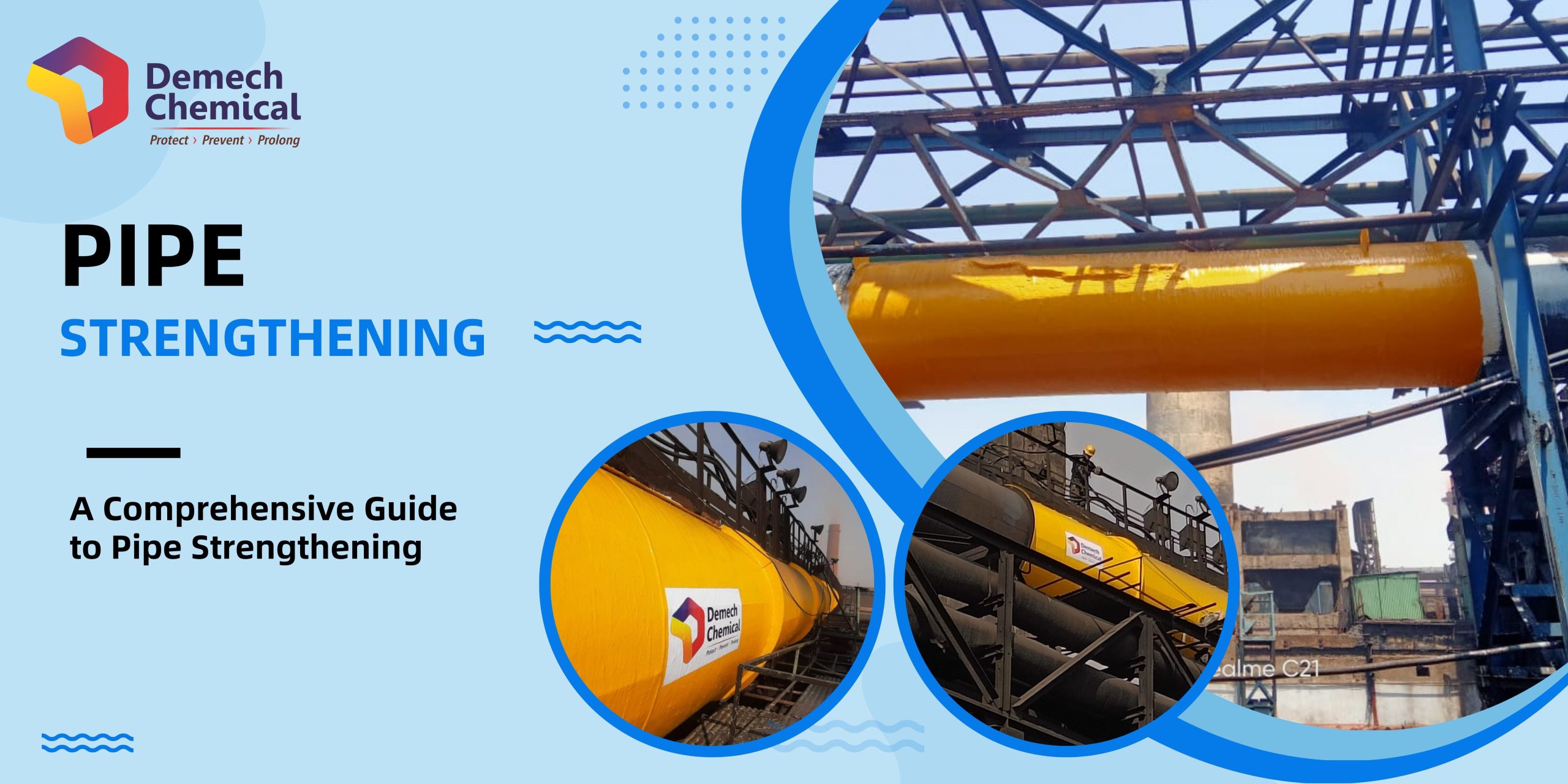
Strengthening Your Pipes: A Comprehensive Guide to Pipe Strengthening
Pipe strengthening is one of the most effective methods for extending the service life of industrial pipelines while reducing maintenance costs and preventing unexpected failures. Pipelines transport water, chemicals, oil, gas, slurry, steam, and other critical process fluids, making them an essential part of every industrial facility.
Over time, pipelines are exposed to corrosion, erosion, abrasion, chemical attack, pressure fluctuations, and mechanical damage. If left untreated, these issues reduce wall thickness, create pits, cause leakages, and eventually lead to pipeline failure.
At Demech Chemical Products Pvt. Ltd., we provide advanced pipe strengthening and rehabilitation solutions using high-performance composite repair systems such as Combiwrap®, along with specialty repair compounds and protective coatings that restore pipeline integrity without costly replacements.
What Is Pipe Strengthening?
Pipe strengthening is a repair and rehabilitation process that restores the structural strength of damaged or weakened pipelines without replacing the entire section.
Modern composite repair systems reinforce the pipe externally while protecting it against further corrosion, leakage, and mechanical damage. These systems are engineered to meet demanding industrial applications and significantly increase pipeline reliability.
Pipe strengthening is widely used for:
- Corroded pipelines
- Leaking pipes
- Thinning pipe walls
- Pitted surfaces
- Mechanical damage
- Pressure-bearing pipelines
- Aging pipeline infrastructure
Why Is Pipe Strengthening Important?
Industrial pipelines operate under harsh environmental and process conditions. Continuous exposure to moisture, chemicals, seawater, abrasive materials, and high temperatures gradually weakens the pipe structure.
Without proper protection, pipelines may experience:
- Internal corrosion
- External corrosion
- Pitting corrosion
- Wall thickness reduction
- Pinhole leaks
- Structural weakness
- Unexpected shutdowns
- Expensive pipe replacement
Implementing pipe strengthening at the right time helps industries avoid catastrophic failures while maximizing equipment life.
Benefits of Pipe Strengthening
A professionally designed pipe strengthening system offers several advantages:
- Extends pipeline service life
- Arrests active leakages
- Restores structural strength
- Protects against corrosion and erosion
- Reduces maintenance frequency
- Eliminates unnecessary pipe replacement
- Minimizes plant downtime
- Improves operational safety
- Lowers lifecycle maintenance costs
- Provides rapid on-site repair solutions
Demech's Advanced Pipe Strengthening Solutions
Demech Chemical Products Pvt. Ltd. offers complete pipeline rehabilitation systems for damaged metallic pipelines.
Our solutions combine:
- Combiwrap® Composite Repair System
- Metal Magic Steel Stick
- Steel Putty
- Fast Cure Steel Putty
- High-performance protective coatings
- Corrosion-resistant lining systems
These products work together to repair damaged pipelines, strengthen weakened sections, and provide long-term corrosion protection.
Our composite repair technology is suitable for both planned maintenance and emergency leak repair.
Applications of Pipe Strengthening
Our pipe strengthening systems are suitable for numerous industrial sectors, including:
- Oil & Gas
- Petrochemical Plants
- Chemical Processing Industries
- Refineries
- Fertilizer Plants
- Steel Plants
- Thermal Power Stations
- Cement Industries
- Marine Applications
- Mining Industries
- Water Treatment Plants
- Wastewater Treatment Facilities
Step-by-Step Pipe Strengthening Process
1. Pipeline Inspection and Assessment
Every successful repair begins with a detailed inspection to evaluate:
- Corrosion severity
- Wall thickness loss
- Leak location
- Structural damage
- Operating pressure
- Surface condition
This assessment helps determine the most suitable repair methodology.
2. Surface Preparation
Proper surface preparation is essential for achieving strong adhesion.
The damaged area is:
- Cleaned thoroughly
- Rust removed
- Oil and contaminants eliminated
- Surface roughened where required
This creates the ideal bonding surface for repair compounds and composite wraps.
3. Damage Repair
Depending on the condition of the pipeline, steel repair compounds are applied to:
- Fill pits
- Repair cracks
- Seal pinholes
- Restore damaged metal surfaces
Fast-curing materials minimize downtime during emergency repairs.
4. Composite Pipe Strengthening
The Combiwrap® composite system is wrapped around the damaged section.
The composite wrap:
- Restores structural strength
- Reinforces weakened pipe walls
- Distributes operating stress
- Prevents further damage
- Increases pressure-bearing capability
5. Protective Coating Application
Specialty anti-corrosion coatings are applied whenever required to provide long-term resistance against:
- Chemicals
- Moisture
- Abrasion
- Weathering
- Corrosion
6. Final Inspection and Quality Testing
After installation, the repaired section undergoes:
- Visual inspection
- Dimensional verification
- Pressure testing (where applicable)
- Performance evaluation
This ensures long-lasting and reliable pipeline performance.
When Should You Consider Pipe Strengthening?
Pipe strengthening should be considered whenever pipelines show signs of deterioration or damage.
Typical situations include:
Corrosion Damage
Internal or external corrosion reduces pipe wall thickness and weakens structural integrity.
Active Leaks
Composite repair systems can quickly arrest leaks without replacing the pipeline.
Wall Thinning
Aging pipelines often experience gradual metal loss due to corrosion or erosion.
Mechanical Damage
Impact, vibration, or accidental damage can compromise pipeline strength.
Preventive Maintenance
Strengthening vulnerable pipelines before failure reduces future repair costs.
Pipeline Life Extension
Instead of replacing expensive pipelines, strengthening provides a cost-effective rehabilitation solution.
Why Choose Demech Chemical Products Pvt. Ltd.?
Demech has decades of experience in corrosion protection, composite repair, and industrial maintenance solutions.
Our advantages include:
- Proven composite repair technology
- High-performance specialty coatings
- Industry-specific repair solutions
- Expert technical support
- Fast on-site application
- Cost-effective rehabilitation methods
- Long-lasting pipeline protection
We help industries maximize asset life while reducing maintenance costs and operational downtime.
Industries That Benefit from Pipe Strengthening
Our pipe strengthening solutions are extensively used in:
- Oil & Gas Pipelines
- Offshore Platforms
- Refineries
- Petrochemical Plants
- Power Generation
- Mining Operations
- Marine Infrastructure
- Chemical Manufacturing
- Water Distribution Systems
- Industrial Process Plants
Frequently Asked Questions (FAQs)
1. What is pipe strengthening?
Pipe strengthening is a repair and rehabilitation technique that restores the structural integrity of damaged pipelines using composite wraps, repair compounds, and protective coatings instead of replacing the entire pipe.
2. What causes pipelines to require strengthening?
Common causes include corrosion, erosion, abrasion, wall thinning, pitting, mechanical damage, pressure fluctuations, and chemical attack.
3. How does the Combiwrap® system work?
Combiwrap® is a composite repair system that wraps around the damaged pipe section, restoring strength, sealing defects, and protecting against further deterioration.
4. Is pipe strengthening suitable for leaking pipelines?
Yes. Composite repair systems combined with repair putties can effectively arrest leaks and reinforce damaged pipelines while minimizing downtime.
5. Which industries use pipe strengthening?
Pipe strengthening is widely used in oil & gas, petrochemical, power plants, mining, marine, chemical processing, water treatment, cement, and steel industries.
6. Can pipe strengthening replace pipeline replacement?
In many cases, yes. Pipe strengthening provides a cost-effective alternative to replacing pipelines, especially when the damage is localized and the pipe remains structurally repairable.
7. How long does a composite pipe repair last?
When properly designed, installed, and maintained, composite repair systems can provide many years of reliable service while protecting against further corrosion and damage.
8. Does pipe strengthening reduce maintenance costs?
Absolutely. It extends pipeline life, reduces emergency shutdowns, minimizes replacement costs, and lowers overall maintenance expenses.
9. Can strengthened pipes withstand harsh industrial environments?
Yes. Demech's composite repair systems and protective coatings are engineered to resist corrosion, chemicals, abrasion, moisture, and challenging industrial operating conditions.
10. Why choose Demech for pipe strengthening?
Demech Chemical Products Pvt. Ltd. offers complete pipeline rehabilitation solutions backed by advanced composite repair technology, specialty coatings, experienced engineers, and proven industrial expertise.
Conclusion
Pipe strengthening is a proven and economical solution for restoring damaged pipelines, preventing corrosion, and extending the operational life of critical infrastructure. Instead of costly pipeline replacement, industries can rely on advanced composite repair systems like Combiwrap® to reinforce weakened pipelines, arrest leaks, and maintain safe, uninterrupted operations.
Whether you need emergency pipeline repair or long-term corrosion protection, Demech Chemical Products Pvt. Ltd. delivers reliable, high-performance solutions tailored to your industrial requirements.
Contact Demech Chemical Products Pvt. Ltd.
Email: enquiry@demechchemical.com
Phone: +91 8240281662
WhatsApp: +91 8378996952
Website: https://www.demechchemical.com


We are looking to obtain a quotation for the leakage sealing Technique for pipe , and we would appreciate it if you could provide us with the details based on the following specifications:
Project Specifications:
Working Media in Pipe: COG Gas
Pipe Diameter: 24 inches
Length of Repair: 50 meters
Pressure: 0.1 kg/cm²
Temperature: 60°C
Thank you for your inquiry. We have solutions for leakage sealing of pipelines. Kindly share your GST details and any specific site conditions at sougan@demechchemical.com
, and we will send you our best quote.
We are looking to obtain a quotation for the leakage sealing Technique for pipe , and we would appreciate it if you could provide us with the details based on the following specifications:
Project Specifications:
Working Media in Pipe: COG Gas
Pipe Diameter: 24 inches
Length of Repair: 50 meters
Pressure: 0.1 kg/cm²
Temperature: 60°C
Thanks and Regards,
Rahul Turkar
Senior Engineer – Projects
Mob- 7875918763
Thank you for your inquiry. We have solutions for leakage sealing of pipelines. Kindly share your GST details and any specific site conditions at sougan@demechchemical.com
, and we will send you our best quote.